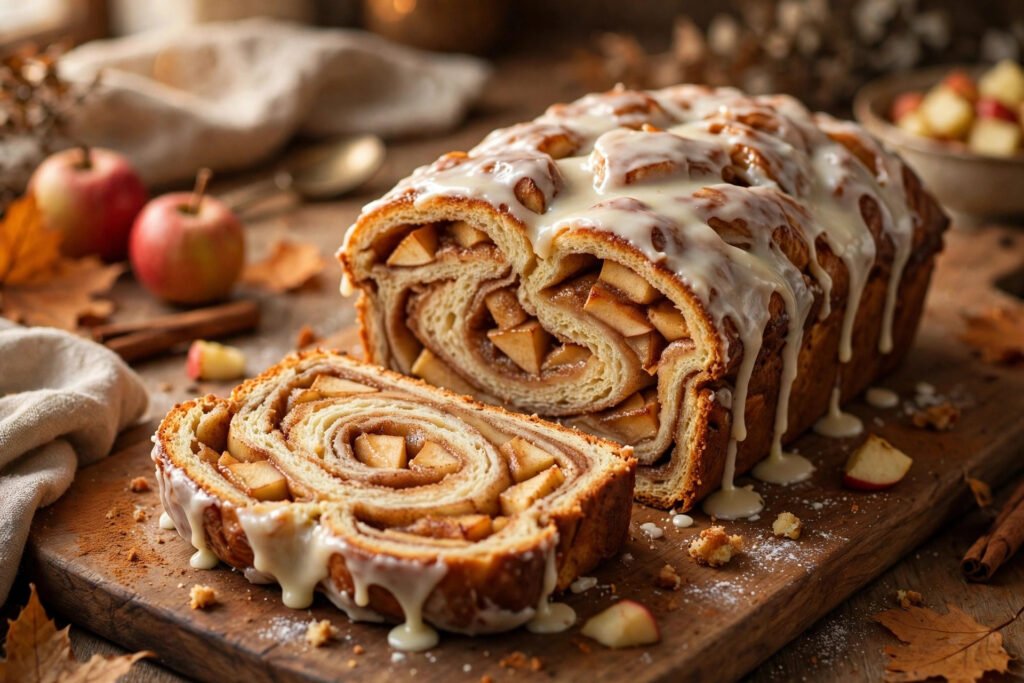
An apple fritter is a perfect food with one flaw: it requires standing over a pot of hot oil. This loaf takes the fritter’s whole personality (soft dough, cinnamon apples in every bite, a glaze that sets into a thin shell) and bakes it in a loaf pan instead. The sourdough base keeps it from being one-note sweet, and the slices pull apart in layers, which is the correct way to eat it: standing at the counter, “just checking” the glaze.
One technique carries the whole recipe: cook the apples first. Raw apples weep juice into dough as it bakes and leave you with a soggy stripe at the bottom of the loaf. Five minutes in a pan with butter and a spoonful of flour, and the filling behaves itself completely.
The formula
Dough
| Ingredient | Amount | Baker’s % |
|---|---|---|
| Bread flour | 400 g | 100% |
| Whole milk | 120 g | 30% |
| Active sourdough starter, at peak | 80 g | 20% |
| Granulated sugar | 40 g | 10% |
| Egg, room temperature | 1 large (50 g) | 12.5% |
| Butter, soft | 45 g | 11% |
| Fine sea salt | 8 g | 2% |
Apple filling
| Ingredient | Amount |
|---|---|
| Firm apples (Granny Smith, Honeycrisp, or a mix), peeled and diced small (about 1 cm) | 2 medium, about 300 g prepared |
| Butter | 20 g |
| Brown sugar | 60 g |
| Cinnamon | 2 tsp |
| All-purpose flour | 1 tbsp |
| Lemon juice | 1 tsp |
| Fine sea salt | a pinch |
Vanilla glaze
| Ingredient | Amount |
|---|---|
| Powdered sugar | 100 g |
| Milk | 18–22 g |
| Vanilla extract | ½ tsp |
| Fine sea salt | a pinch |
Yield: one 9×5-inch loaf.
Schedule
Same day: feed the starter in the morning, mix the dough midday, bulk ferment through the afternoon, fill and shape in the late afternoon, proof, and bake in the evening. Glaze with something good on TV.
Split over two days: bulk ferment the dough, then refrigerate it overnight before shaping. Cold dough rolls out without fighting you, and the flavor deepens. This is the easier version, not the compromise.
Method
1. Mix and bulk ferment (3–4 hours)
Mix the flour, milk, starter, sugar, and egg into a rough dough. Rest 20 minutes. Add the salt and soft butter in two additions, kneading until each disappears into the dough. Knead to smooth and elastic, 8–10 minutes. The dough should be soft and supple, not stiff.
Bulk ferment at warm room temperature until risen about 75% and puffy, with 2 sets of gentle folds in the first hour. Enriched doughs ferment slowly; give it the time.
2. Cook the filling (5–6 minutes) and cool it completely
Melt the butter in a skillet over medium heat. Add the apples, brown sugar, cinnamon, flour, lemon juice, and salt. Cook, stirring, until the apples are just softened at the edges and the juices have thickened into a glossy sauce that coats them, 5–6 minutes. The flour is doing quiet, essential work here: it turns the juice into a sauce that stays in the loaf instead of flooding it.
Spread the filling on a plate and cool it completely. Warm filling melts the butter in the dough and makes shaping a landslide. Cool filling, always.
3. Roll, fill, slice, stack
On a lightly floured surface, roll the dough into a rectangle about 30 × 40 cm (12 × 16 in). Spread the cooled apple filling evenly over it, leaving a 2 cm border on one long edge. Roll up from the other long edge into a snug log, pinching the seam shut.
Now the fritter move: cut the log into 12 equal slices, like cinnamon rolls. Grease and parchment-line a 9×5 loaf pan, then stand the slices in the pan in two leaning rows, cut sides facing out, so the apple layers show. It will look slightly chaotic. It is supposed to. The proof evens everything out.
4. Final proof (1½–2½ hours)
Cover and proof until the loaf has puffed to the rim of the pan and the layers press into each other with no gaps. A fingertip pressed into the dough should spring back slowly and leave a slight indent. Underproofed fritter bread bakes up with a raw stripe in the center; this is the stage that decides it.
5. Bake
Bake at 175°C (350°F) for 40–45 minutes, until the top is deep golden and the center reads 88–90°C (190–195°F). The sugary filling darkens the top faster than a plain loaf, so tent loosely with foil at the 30-minute mark if it is coloring ahead of schedule. The internal temperature is the truth here, not the color.
6. Glaze and serve
Cool in the pan 15 minutes, then lift the loaf out. Whisk the glaze to a thick ribbon and drizzle it over the warm loaf, letting it run into the layers. Wait 10 minutes for the glaze to set into its shell. Slice thick, or pull pieces apart with your hands. Both are correct.
Troubleshooting
A soggy stripe at the bottom. The filling went in raw, or undercooked. This is the one this recipe is built to prevent: cook the apples until the juices thicken, use the flour, and cool the filling before it touches dough.
The center is raw while the top is dark. Underproofed, or the filling was piled thicker in the middle. Proof to the rim, spread the filling evenly, tent at 30 minutes, and trust the thermometer over the clock.
The layers separated into gaps. The roll was loose, or the filling was warm and slippery. Roll snugly, cool the filling, and let the proof press the layers together.
The apples turned to mush. They were diced too small or cooked too long. One-centimeter dice, and stop cooking when the edges just soften; they finish in the oven.
The glaze disappeared into the loaf. The loaf was too hot when glazed. Fifteen minutes of cooling first, then glaze. For a thicker shell, glaze once, wait 5 minutes, glaze again.
Variations
- Pear and cardamom: swap the apples for firm pears and the cinnamon for 1 teaspoon of cardamom plus 1 teaspoon of cinnamon. Elegant is not a word this page uses often, but here we are.
- Nut crunch: scatter 50 g of chopped toasted walnuts or pecans over the filling before rolling. Texture in every layer.
- Brown butter glaze: brown the butter, whisk it into the powdered sugar with just enough milk to ribbon. It tastes like the fritter shop at its best.
Storage
Best on bake day. Keeps 2 days covered at room temperature; refresh slices in a 150°C (300°F) oven for 6–8 minutes and the glaze softens back up. Freezes well for a month, sliced and wrapped; thaw and warm before eating. Do not refrigerate the loaf.
FAQ
Which apples are best? Firm and tart wins: Granny Smith holds its shape and its bite. Honeycrisp is excellent too. Soft, sweet eating apples like Gala collapse into sauce, which has its charms but makes a wetter loaf.
Can I use discard instead of active starter? This dough needs a genuine rise, so active starter is the right call. Very fresh discard plus a longer, warmer proof can work, but the texture will be denser.
Can I skip the slicing and bake it as a swirl loaf? Yes: roll it up, seam down, straight into the pan. You lose the pull-apart layers and gain a cleaner slice. The filling rules stay exactly the same.
My dough tore while rolling. It was under-rested or rolled too thin. Let it relax 10 minutes under a towel, then roll again, and keep the rectangle no thinner than about 8 mm.
Apple season runs all month here: the baked apple cider donuts in Sweet Baking use the same orchard logic, reduced cider and all. If your loaf goes wrong in a new way, the Troubleshooting section wants to hear about it.