
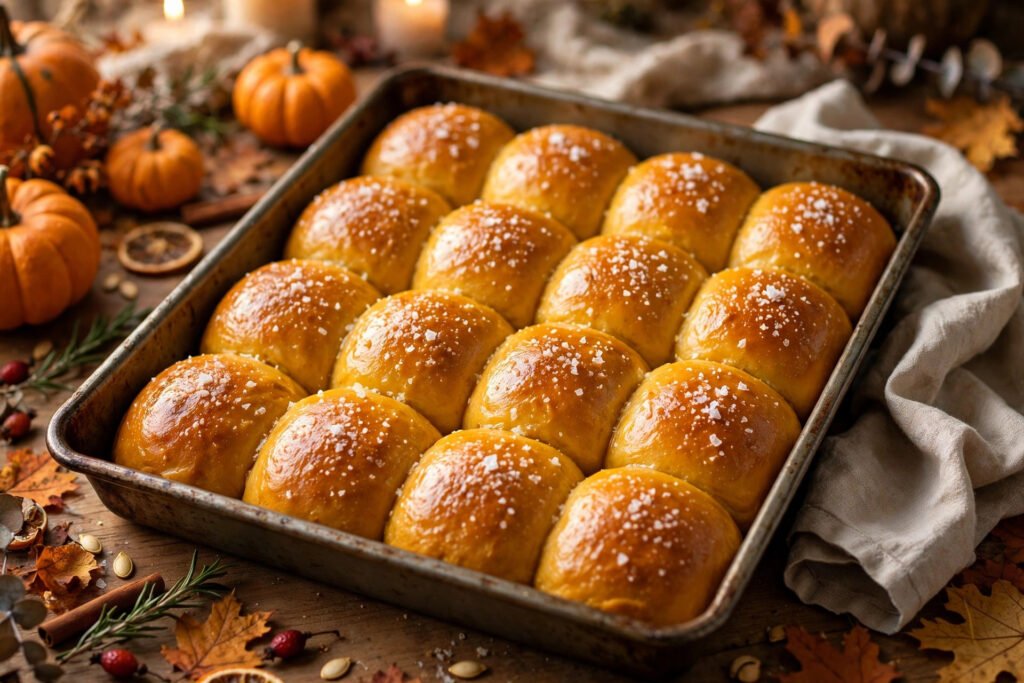
These are the rolls that make people ask which bakery they came from. Soft and golden from pumpkin puree, with enough sourdough in them to taste like real bread instead of cake, and a brush of salted maple butter over the tops while they are still hot. Twelve rolls, one pan, and a plan that lets you do nearly all of the work before Thanksgiving Day.
The plan is the point. Rolls are always the thing someone is trying to proof in a chaotic kitchen while a turkey takes up the oven. This dough is shaped the day before and held in the fridge overnight, so on the day you are only proofing, baking, and accepting compliments.
The formula
Dough
| Ingredient | Amount | Baker’s % |
|---|---|---|
| Bread flour | 480 g | 100% |
| Pumpkin puree (plain, not pie filling) | 180 g | 37.5% |
| Whole milk, warm | 120 g | 25% |
| Active sourdough starter, at peak | 100 g | 21% |
| Brown sugar | 25 g | 5% |
| Egg, room temperature | 1 large (50 g) | 10% |
| Butter, melted and cooled | 57 g | 12% |
| Fine sea salt | 10 g | 2% |
Salted maple butter (for brushing)
| Ingredient | Amount |
|---|---|
| Butter | 45 g |
| Maple syrup | 20 g |
| Flaky sea salt | ½ tsp, plus more to finish |
Yield: 12 rolls, about 78 g each, in a 9×13-inch pan.
The schedules
Thanksgiving plan (recommended): Mix and bulk ferment Wednesday morning or afternoon. Shape Wednesday evening, cover, refrigerate up to 16 hours. Thursday: pull the pan out 1½–2 hours before you want to bake, let the rolls puff until they are touching and pillowy, then bake. They hold their place in line for the oven politely, anywhere in a 2-hour window.
Same-day plan: Mix in the morning, bulk 3–4 hours, shape, proof 1½–2 hours, bake. Done by lunch, still warm by dinner if you reheat them wrapped in foil for 8 minutes.
Method
1. Mix and knead
Whisk the warm milk, pumpkin puree, starter, brown sugar, and egg together. Add the flour and mix to a rough dough, then add the melted butter and salt. Knead 8–10 minutes by machine or 10–12 by hand, until the dough is smooth, elastic, and only slightly tacky. Enriched doughs feel sticky at first and come together with work; resist adding flour in the first 5 minutes. If it is still soup after real kneading, add flour a tablespoon at a time.
2. Bulk ferment (3–4 hours)
Cover and ferment at warm room temperature until the dough has risen about 75% and feels puffy. Enriched dough with butter and egg ferments slower than a lean loaf, and pumpkin slows nothing but adds moisture. Be patient here. Under-fermented dough is the number one reason homemade rolls come out dense, and no amount of final proof fully rescues it.
3. Shape
Divide into 12 pieces of about 78 g. Flatten each piece, pull the edges into the center, flip it seam-down, and roll it under a cupped hand on an unfloured surface until the surface is taut. Arrange in a parchment-lined 9×13 pan, 3 by 4, with small gaps between them. They will grow into each other, which is what makes the sides soft.
4. Proof
For the fridge plan: cover tightly and refrigerate now, up to 16 hours. For same-day: proof at room temperature 1½–2 hours, until the rolls are touching, puffy, and a fingertip pressed into one leaves a slow, partial spring-back.
Out of the fridge, the rolls need 1½–2 hours on the counter before baking. Cold dough put straight into the oven bakes up heavy. Set the pan somewhere warm while the turkey rests; the timing works out.
5. Bake
Heat the oven to 190°C (375°F). Brush the tops gently with a little beaten egg or milk. Bake 22–26 minutes, until deeply golden and the center roll reads 88–90°C (190–195°F). If the tops color early, tent with foil for the last 8 minutes.
6. The maple butter finish
While the rolls bake, melt the butter with the maple syrup and flaky salt. Brush it over the hot rolls the moment they come out, generously, and add one more pinch of flaky salt over the pan. Serve warm. The tops will be glossy, salty-sweet, and the reason these get requested.
Troubleshooting
Dense, heavy rolls. Under-fermented bulk, or baked cold from the fridge without the counter rest. Give the bulk its full rise and respect the warm-up.
Pale tops. No wash, or the oven runs cool. Egg wash gives the deepest color; milk gives a softer gold. Also check the rolls are in the middle of the oven, not the bottom.
Rolls tore open at the sides. Shaped without enough surface tension, or proofed too long so they had nothing left for the oven. Roll them taut, and bake when the poke test says ready, not when the clock does.
Dry by the next day. Enriched rolls stale like all bread. Store airtight once fully cool, and reheat wrapped in foil at 150°C (300°F) for 8–10 minutes. They will taste fresh-baked again.
Too sweet / not sweet enough. The dough itself is barely sweet; the maple butter carries it. If you want a sweeter roll for a breakfast table, raise the brown sugar to 40 g. For a strictly savory table, skip the maple in the brush and use plain salted butter.
Variations
- Sweet potato rolls: swap the pumpkin puree for the same weight of mashed roasted sweet potato. Same dough, deeper color, and the sanctioned way to use up the extra sweet potatoes you roasted for the casserole.
- Herb rolls: skip the maple, add 1 tablespoon of finely chopped rosemary or sage to the dough, brush with garlic butter. For the gravy, not the jam.
- Cloverleaf style: divide each piece into 3 small balls and set all three in a greased muffin cup. Old-fashioned, pretty, and the pieces pull apart.
Storage and freezing
Room temperature, airtight, 2 days. To freeze baked rolls: cool completely, bag them tight, freeze up to a month. Reheat from frozen, wrapped in foil, at 150°C (300°F) for 12–15 minutes. You can also freeze the shaped, unbaked pan; thaw overnight in the fridge, then follow the fridge-plan proof.
FAQ
Can I use discard instead of active starter? Fresh discard, less than 2 days old, will work because this dough also leans on a long ferment; very old discard will not lift enriched dough reliably. When in doubt, feed the starter. Thanksgiving is not the day to gamble.
Can I make these without pumpkin? Yes. Replace the puree with 180 g of mashed potato or sweet potato, or with 150 g of extra milk plus 30 g of flour for a plain roll. The pumpkin version is the one people remember, though.
My kitchen is cold. Where should the dough rise? An oven with the light on and the door cracked usually sits around 24–26°C, which is perfect. A cold kitchen can add an hour to every stage, so plan by the dough’s look, not the clock.
Do these need a stand mixer? No. The dough is soft enough to knead by hand, and the slap-and-fold method works well: lift, slap onto the counter, fold, repeat for 8 minutes.
Baking the whole meal? The Everyday Breads section has the everyday loaf for the leftover-turkey sandwiches, and the Troubleshooting section covers dense rolls and every other way bread misbehaves.